


How personalization is reshaping the way investment managers market themselves.
Attention could be considered the most precious, finite resource of the digital age. Our Netflix, Amazon, LinkedIn, and Spotify algorithms get us, and are getting better at feeding us content that we like, keeping our attention. The success of these platforms is largely due to personalization.

In the world of investment management, the same conditions prevail. Investors are bombarded with content, and so are more selective than ever. Whether you're communicating with an institutional allocator, an IFA, or a wealth manager, generic messaging no longer cuts through. Inboxes and feeds are full. Attention is short. And with so many options, the cost of irrelevance is highly relevant.
The investment managers that are winning today are those that treat personalization not as something that retail marketers do, but as a core part of their marketing infrastructure.
AI, Joan of Arc, and Genghis Khan
For decades, investment manager marketing defaulted to a broadcast model: one market commentary, one newsletter, one campaign, sent to everyone. The problem is that what matters to a pension fund CIO is not the same as what matters to a discretionary portfolio manager.

The shift we have seen is from broadcasting to precision targeting. Harvard University made an important point in their AI Marketing Course - audience segmentation divides people into groups based on shared characteristics - teenage girls, people travelling with pets, adults with children, etc., then markets to the group. It's a reasonable starting point, but it misses a lot. Joan of Arc was a teenage girl, Hannibal travelled with pets (elephants), and Genghis Khan had lots of children. The thing that unites them is that they were all generals, but they likely had very little in common with their segments.
AI personalization works differently. Instead of grouping by assumed similarity, it analyses real-time signals - behavior, preferences, content engagement, context - to build a picture of each individual and deliver relevant experiences at scale, automatically. The more data points it draws on, the more precise the output.
This is the basis of what marketers call NBX, the Next Best Experience: an automated workflow that continuously asks; what is the single most relevant thing to show this person right now? For investment managers, that might mean surfacing a private credit outlook to a prospect who just read your latest direct lending insight piece or flagging a lapsed client to your distribution team when their engagement drops off. The logic is automated. The experience feels personal.
AI enables personalization at scale
AI doesn’t necessarily replace people; it compresses the execution layer. The challenge with personalization has always been resource. Crafting tailored messages for dozens of segments, across multiple channels, simply wasn't feasible for most marketing teams. AI changes that.
AI tools analyze behavior across your digital ecosystem - content read, emails opened, LinkedIn engagement - and use that data to automate relevant content delivery. A prospect who repeatedly reads your fixed income commentary gets enrolled in a bond strategy nurture sequence. A client who hasn't engaged in 90 days receives a re-engagement email tied to their mandate.
Using social media targeting to reach investors
LinkedIn remains the most effective social media platform for investment managers, and its targeting capabilities are more powerful than most firms realize.
Beyond simply posting content to your follower base, LinkedIn's paid distribution tools allow you to target using first-party contact details, job title, company size, sector, seniority level, and geography. We often have clients who only want to reach around 2,000 European pension fund CIOs or 1,500 RIAs based in Miami. Gone are the days when you would have to publish endless ads in Institutional Investor or the FT Adviser, in the hopes that they see it.
We can now track their engagement with the client as they move along the marketing funnel. Real ROI can be measured -
"Half the money I spend on advertising is wasted; the trouble is I don't know which half"
– not so anymore.
If the data is faulty, inconsistent, biased, or incomplete, the AI learns false correlations or confused signals, leading to unreliable outputs. X is an example of a platform with bad legacy data, which makes their targeting unreliable. LinkedIn is an example of clean data (job title, company, industry, etc.), which is continuously updated by the members themselves.
Use a CRM to personalize content for your investors
Social media and AI tools are only as effective as the underlying data infrastructure that supports them. This is where CRM platforms like HubSpot become essential.
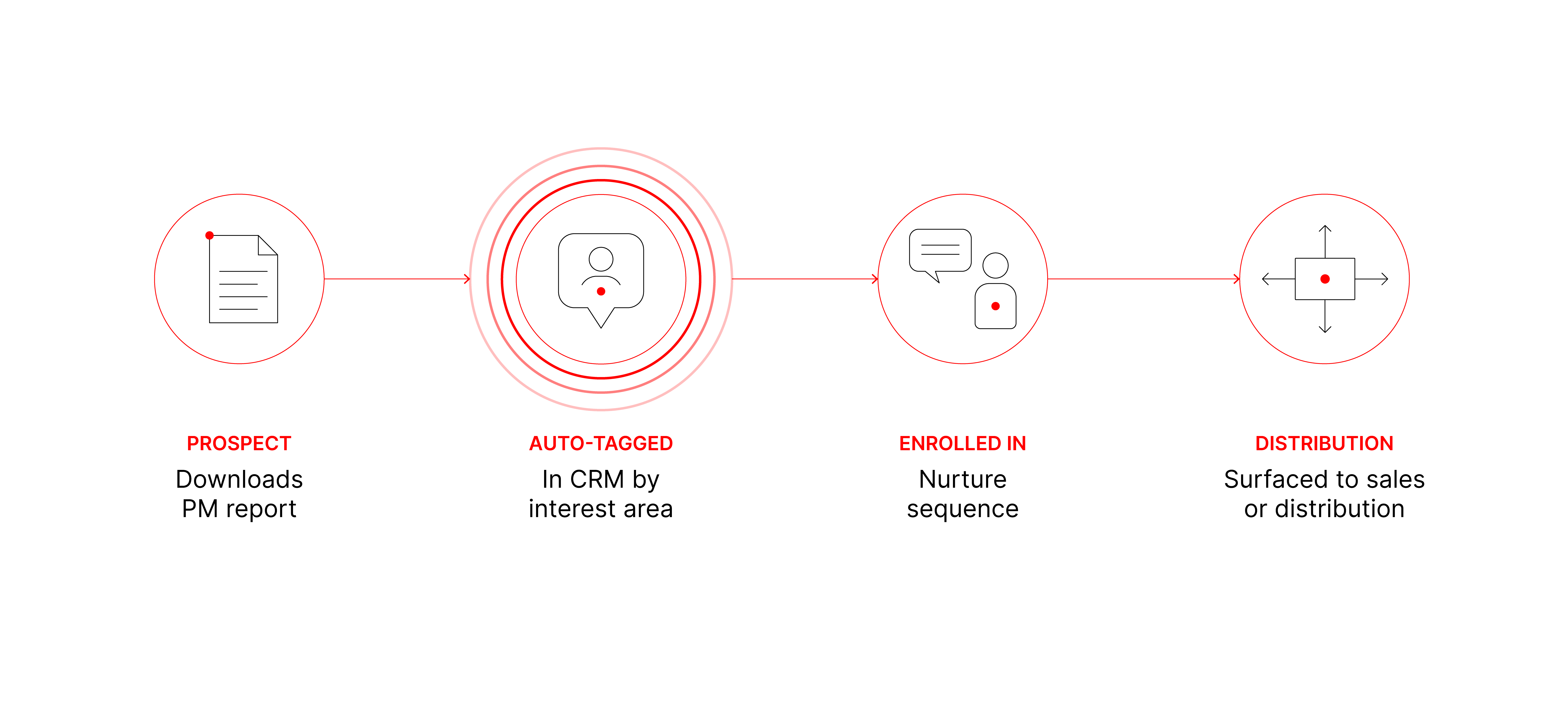
HubSpot's workflows allow you to automate these journeys without losing the sense of relevance. A prospect who downloads your private markets report can be automatically tagged, added to a relevant nurture sequence, and surfaced to the appropriate sales or distribution contact, all without manual intervention. The marketing team sets the logic once; the system does the work continuously.
 One of the most underutilized opportunities in investment management digital marketing is the website itself. Most firms still serve the same homepage, the same content, and the same calls-to-action to every visitor, regardless of whether they're a first-time prospect, a returning client, or an institutional allocator with a specific mandate in mind.
CRM integrations now make it possible to change that. Using tools like HubSpot's smart content functionality, firms can dynamically adapt what a visitor sees based on what the CRM already knows about them.
5 Practical steps investment managers can take
Personalization at this level doesn't require a complete technology overhaul. Most firms already have the building blocks: a CRM, a website, a social media presence, and an email platform. The opportunity is in connecting them more effectively.
-
Audit your CRM data. Are your contacts properly segmented by investor type and lifecycle stage? Clean data is the foundation of everything else.
-
Map your content to your audiences. Identify which pieces of thought leadership are most relevant to which segments and build simple email journeys around them.
-
Test LinkedIn targeting on your next campaign. Rather than boosting a post broadly, define a specific audience profile and measure engagement quality, not just reach. Set up retargeting to reach investors who are already engaging on your website.
-
Introduce smart content on one page of your website. Start with the homepage or a key product page, and test what difference personalized calls-to-action make to conversion.
-
Review your analytics with a behavioral lens. Which content types are driving the most engagement from which segments? Let that data shape your editorial priorities.
Personalization, done well, isn't about technology. It's about respect for your audience's time, and a clear-eyed understanding of what they need from you.