


Asset management marketing: how positioning drives performance.
It’s becoming harder to command attention. Audiences are expensive to reach, sceptical and time poor.
Yet some managers consistently cut through. Their advertising is more authentic, more relevant and more memorable than peers. The difference isn’t necessarily budget. Rather, it is the discipline of a strong central idea and the confidence to express it simply.
The Challenges
Costly Digital Real Estate
Your audience sits in one of the most expensive advertising categories online. Finance and insurance keywords routinely cost multiples of retail equivalents.
High competition and client value push prices up, particularly for tightly defined audience segments. North American-based audiences within this subset are even more expensive.
Layer on precise targeting of allocators, advisers or institutional buyers and you are bidding in the narrowest, most contested pools.
Industry consolidation is narrowing the “reachable middle” meaning firms end up bidding on the same finite pools of decision-makers across the same premium environments.
McKinsey describes a widening gap between leaders and the rest, with the sector rebounding in AUM but not in profitability, which keeps pressure on costs (including marketing) and efficiency.1
In short, your audience is valuable, scarce and increasingly costly to reach.
Competing for Attention
Today’s fast-paced media environment is the most sophisticated information and ideas marketplace ever created. With the proliferation of AI, it’s also evolving at warp speed.
Research from the University of California has shown that knowledge workers switch screens or tasks roughly every 47 seconds.2 We skim, scroll and move on.
If you have read this far you have defied those odds.
Asset managers are not just competing with other managers but also with the cognitive load of the working day.
AI has also lowered the barrier to entry for content production. Generative tools can draft headlines, produce imagery and optimise media placements at scale. That increases supply and reduces friction.
There is an upside. As volume rises, authenticity becomes more valuable. Brands with a clear point of view, distinctive assets and disciplined messaging stand out sharply against a backdrop of algorithmically determined, inertia-inducing sameness.
How to win
When we work on an advertisement, website or video script with clients, we always ask:
Is the message authentic? How well does it harmonise with the manager’s core strengths?
Is it relevant to the audience?
Is it distinctive versus competitors?
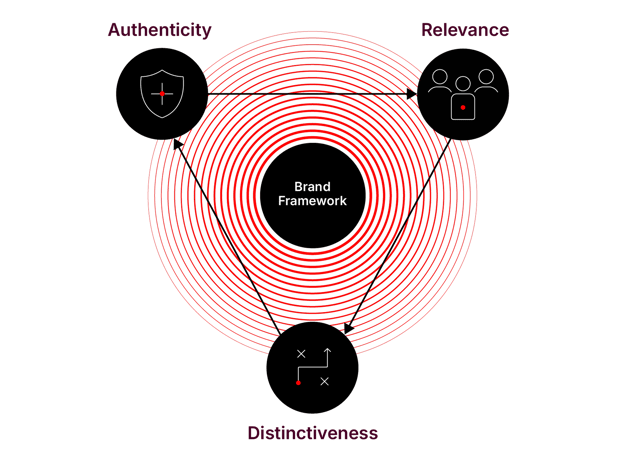
Authenticity
This is the age of misinformation, greenwashing and AI-produced content. Using its Trust Barometer,3 Edelman finds that, globally, only “my employer” at 78% and business at 64% sit in trust territory; NGOs at 58%, media at 54% and government at 53% rather less so. At the same time, 7 in 10 people have an insular trust mindset, meaning they are hesitant or unwilling to trust those who feel different from them. Only 39% say they get information from sources with a different political leaning at least weekly, and 76% say distrust between people with different beliefs and backgrounds is at least a moderate problem in their country.
In that environment, your brand must feel true. Authenticity is not about louder purpose language. It is about consistency between what a firm says, what it actually does, and what people already know to be true about it.
That is precisely why Vanguard’s advertising feels so authentic. Vanguard’s positioning is built around bringing value to investors, and its recurring “V” hand gesture turns that promise into a simple, memorable visual device.
And that V for value promise is not empty. Vanguard announced fee cuts which since February 2025 are on track to deliver more than half a billion dollars in savings to investors across 2025 and 2026, with a 0.06% asset-weighted average expense ratio that ranks among the lowest in the industry.4
Vanguard’s promise to “take a stand for all investors” is more than a slogan. It is embedded in the company’s business model. The “V” for value works because it is not inventing a story; it is dramatising a truth the company has spent decades making real.5

A useful contrast is abrdn. The infamous 2021 rebrand was intended to symbolise the movement of money and the free flow of digital data. The issue was not that the ambition was incoherent. The issue was that the expression felt imported. The vowel-stripped name suggested a kind of digital modernity, but it came across as a borrowed one rather than an organic expression of what the firm already meant to clients. In March 2025 the company officially announced it would revert back to Aberdeen Group plc in order to “remove distractions”, and Reuters reported the reversal as a retreat from a “widely-mocked”6 rebrand.
Vanguard’s advertising leaned on an enduring commercial truth. abrdn started with a stylistic gesture and asked the market to work backwards to the substance. One feels more authentic than the other because the promise and the proof are inseparable.
Distinctiveness
In 2019, Invesco partnered with LIDA, part of the M&C Saatchi Group, to launch ‘Times Change’ across EMEA - one of the most captivating asset management campaigns of recent years. On the surface, it drew from a familiar category code: classical art. But rather than using Old Masters as a predictable shorthand for heritage and authority, Invesco reworked them.7
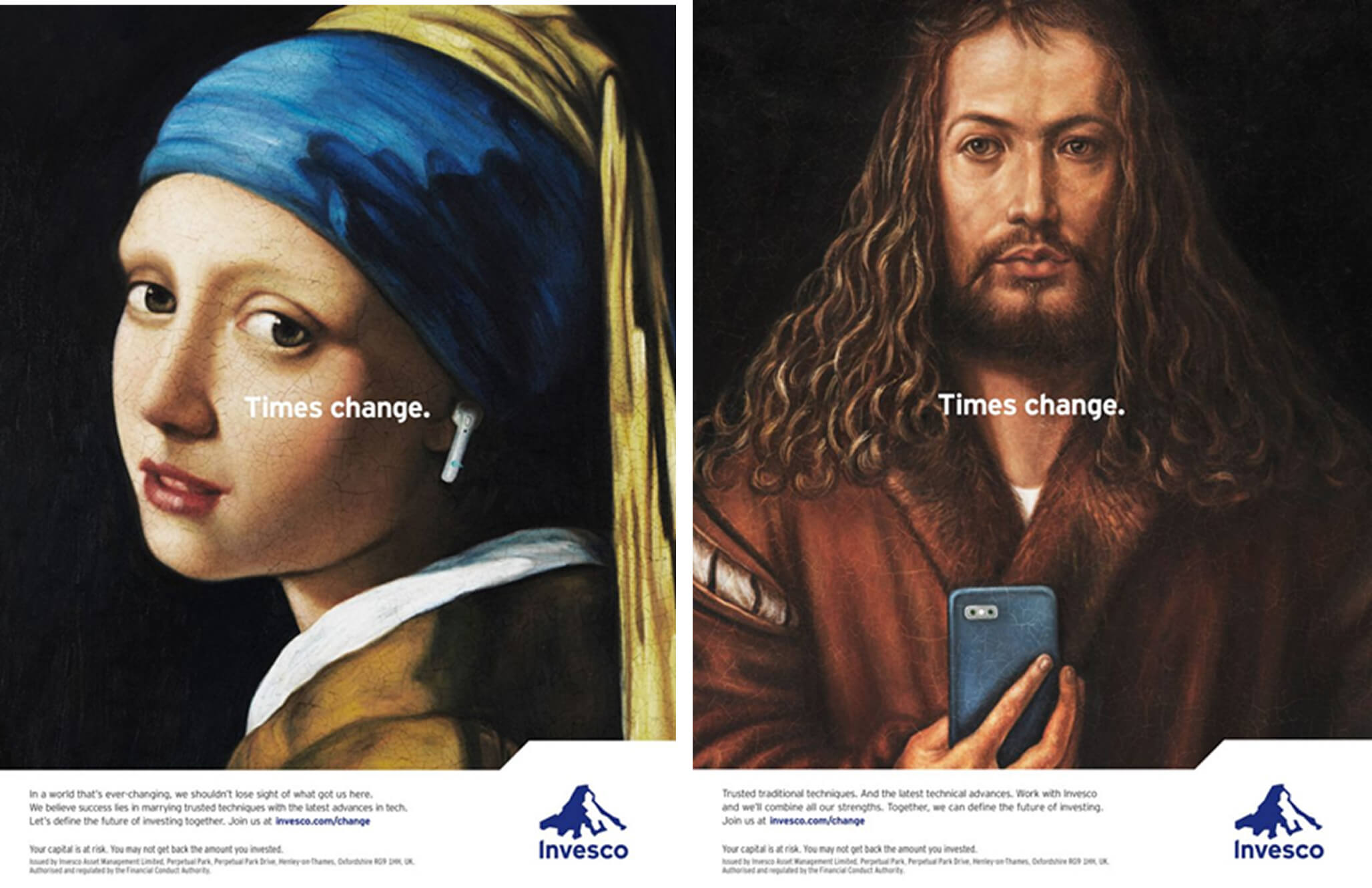
Durer’s Self Portrait at Twenty-Eight held an iPhone. Van Dyck’s Man in Armour wore a VR headset. Vermeer’s Girl with a Pearl Earring appeared with an Apple AirPod. In a single move, the campaign set up a visual tension between permanence and progress.
That tension is exactly what made it distinctive. Other asset managers have long used classical imagery, but usually in a safe, reverential way. Invesco did something distinct: it kept the category cue, then bent it. The viewer recognises the artwork first, then registers the technological intrusion a beat later. That second beat creates a genuine pattern interrupt, forcing a double take and cutting through the visual sameness of the sector.
The repainted Old Masters reduced a complicated institutional story into one instantly legible tension: tradition and progress, side by side.
Invesco’s CMO said the firm wanted clients to recognise its investments in newer technology, new thematics and new capabilities. ‘Times Change’ performed strongly on engagement, especially web traffic and lead generation. Taken together, that gave the campaign a credible basis for implying that Invesco was better equipped than more static rivals for markets evolving at pace.7
If we hold the campaign up to another in the sector with a similar message, we can see how powerful that discipline is. In Franklin Templeton’s “Your trusted partner for what’s ahead”, Franklin Templeton’s own materials show that the campaign is trying to do several jobs at once: leverage over 75 years of heritage, while signalling trust, and innovation across alternatives (plus customised solutions, ETFs, SMAs, public and private markets, digital assets), and custom tax management.8 None of that is untrue; Franklin Templeton has a broad platform across public and private markets, alternatives and digital assets. But creatively, it becomes a bundle of claims rather than a single, compelling idea.
The difference is one of reduction. To borrow Invesco CMO Matthew Heath’s phrase, advertising is an “art of reduction”.9 Invesco dramatise one contradiction and resolve it in a single image: old world versus new world. Franklin Templeton asks the audience to reconcile several propositions at once: trusted partner, old brand, innovative firm, broad platform, future-ready solutions.
Securing sign off for a dramatic idea in an extremely risk-averse sector can be a tall order. The courage to take this kind of risk is uncommon, but if it were easy everyone would do it.
Relevance
Listen to your audience. A Schroder’s survey,10 based on responses from nearly 1,000 institutional investors and wealth gatekeepers overseeing US$67 trillion in assets, found that eight-in-ten (80%) of global investors planned to increase their use of active management over the coming 12 months, while over half (55%) cited portfolio resilience as their top investment priority. Meanwhile, 94% were concerned about market concentration risk.
Schroders subsequently launched the campaign ‘The Active Edge’. It was a relevant answer to a market problem their clients were already feeling.
Most firms trying to sell capability breadth end up sounding identical. Schroders avoids that trap because ‘The Active Edge’ is also a framing device. It gives the firm a clean organising idea under which research, perspective and solutions can be packaged as one cohesive story.
Taking a different approach, Millennium Management produced a series of videos for its website. On the surface, they are recruitment films. In practice, they are adverts that speak to the central tenet of the business model: at a multi-manager hedge fund, talent is not adjacent to the proposition, it is the proposition.11

The videos repeatedly highlight Millennium’s focus on team building, autonomy and entrepreneurial spirit. That makes them relevant on two levels at once: it attracts the kind of people Millennium wants, and it signals to investors that the firm intends to win through the quality of its people.
Relevance is not about chasing the news cycle. It is about identifying audience needs and making the brand useful in that moment. Schroders addresses the need for active judgement in volatile markets. Millennium addresses the need for entrepreneurial talent while signalling that their ability to attract the best human capital is an edge.
By contrast, generic category claims such as “deliver risk adjusted investment returns for our clients over the long term” may be unobjectionable, but they do little to meet an audience where they are. Successful advertising makes the audience feel understood.
The last word
You compete in an industry where performance alone rarely speaks for itself. Investors want to understand what sets you apart from your competitors and make decisions based on trust and judgment.
As traditional and alternative capabilities blur, differentiation becomes harder to sustain through products or capabilities. What is your ‘north star’ or ‘brand promise’, there are various descriptors in use, but they come to same thing; managers must have a clear view on what they can own.
In Jim Collins’ book Good to Great, he refers to this as a Hedgehog concept and it’s one of Peregrine’s favourite analogies for this concept.
What is the difference between the hedgehog and the fox? The fox has many tactics, but the hedgehog only needs one – rolling up in a ball and being prickly.
A Hedgehog concept is not a goal, strategy, or plan to be the best - it’s an understanding of what you can be the best at. The distinction is critical.
Every company wants to be the best at something, but few articulate, with egoless clarity, what they have the potential to be the best at, and where they cannot compete.
In each successful case, advertising is anchored in a central idea. Practice the art of reduction because you can’t explain your entire philosophy in an IAB standard display unit.
In the strongest examples the message can often be boiled down into a single word:
-
Value - Vanguard
-
Adaptable - Invesco
-
Active - Schroders
-
Talent - Millennium
A strong central idea frames your purpose, keeps communication disciplined and helps build recognition.
In other words:
-
Be authentic.
-
Be relevant.
-
And be distinctive.